

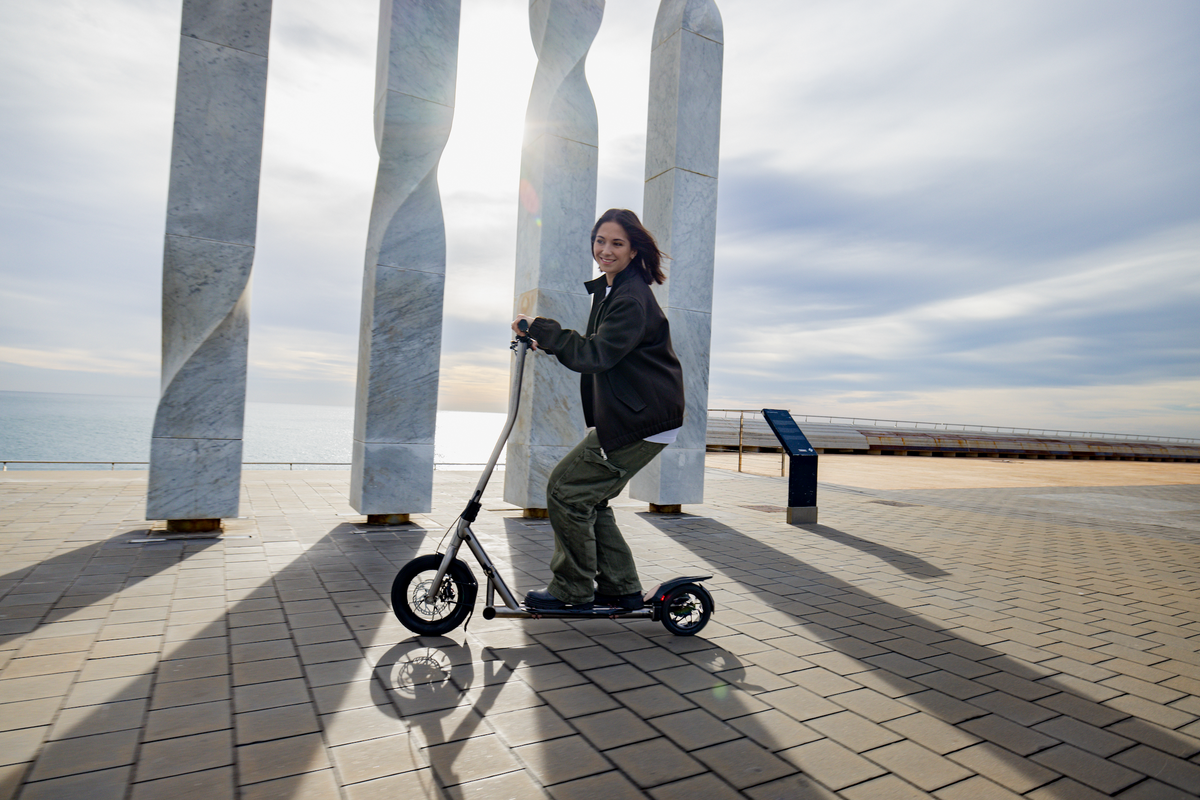
Weight is probably the first thing people notice when they look at a lightweight electric scooter. And for good reason. At 10 kg, a scooter feels very different from the moment you pick it up. It is easier to carry through a building, easier to store at home or at work, and much easier to keep with you throughout the day.
But there is a limit to what weight can tell you.
A scooter can be incredibly light and still be unpleasant to ride. If it feels unstable, flexes too much, vibrates over rough surfaces or leaves you constantly correcting your line, the low weight quickly stops feeling like an advantage.
The real challenge is not simply to make a scooter that is easy to carry. It is to make one that is light enough to fit naturally into everyday life while still feeling like a proper vehicle when you are riding it.
That is the difference between being easy to carry and actually being enjoyable to use.
A lightweight scooter is not automatically a good scooter
Urban mobility has become increasingly focused on numbers. Range, motor power, top speed and weight are all easy to compare, so they tend to dominate the conversation.
They are useful figures, but they only tell part of the story.
A scooter can look impressive on paper and feel disappointing on the road. It might be easy to lift but awkward to control. It might be wonderfully compact when folded but feel nervous once you are moving. And as soon as the road surface becomes less than perfect, any weakness in the design tends to become much more obvious.
This is where the difference between a portable object and a genuine vehicle starts to matter.
A well-designed scooter needs to feel right as a whole. It should be light without feeling fragile, responsive without feeling twitchy, and compact without making you feel like something has been sacrificed to achieve that size.
Lightweight design is valuable when it has been properly engineered. Without that, it is simply a number on a specification sheet.
The problem with being “light but fragile”
There are easy ways to reduce weight. You can remove material, make components smaller or simplify the structure. On paper, all of these decisions make sense.
The difficulty is doing it without compromising the way the scooter feels in everyday use.
If too much is sacrificed, the result can feel flexible, noisy or mechanically weak. Steering can become less precise, the chassis can react badly to imperfections in the road, and the whole scooter can give the impression that it is not quite as solid as it should be.
At that point, being lightweight is no longer an advantage. It becomes something you notice for the wrong reasons.
This is why designing a genuinely good lightweight scooter is difficult. There is simply less room for compromise. When there is less material and less mass, every decision has a greater impact on the final experience.
Reducing the weight without losing the quality of the ride is therefore a real engineering challenge.
Stability comes from the way a scooter is designed
A stable scooter does not have to be a heavy scooter. How stable a scooter feels depends on much more than its overall weight. The geometry, chassis, weight distribution, steering, braking system and folding mechanism all play a role. So does the way the rider's weight is positioned over the vehicle.
A heavier scooter can sometimes feel reassuring simply because there is more mass underneath you. But that extra mass also brings more inertia. The scooter becomes harder to carry and less effortless to move around when you are getting on and off, navigating a station or carrying it up a flight of stairs.
A lightweight scooter can feel just as composed when its structure and geometry have been properly thought through.
What matters is not only how much the scooter weighs, but how it behaves. Does it respond naturally when you turn? Does it stay composed when the road changes? Does the steering feel precise without being overly sensitive? Does the braking feel controlled rather than abrupt?
These are the things that create confidence.
A good scooter should never make you wonder what it is about to do. Its reactions should feel natural enough that you can concentrate on the road rather than on the machine underneath you.
Confidence is part of safety
Safety is often reduced to regulations, speed limits and equipment. Those things obviously matter, but they are only part of the experience.
There is also the simple question of whether you trust the vehicle.
When a scooter responds in a predictable way, you naturally ride with more confidence. You can adjust your trajectory without overthinking it. You know how the brakes will react. Small imperfections in the road feel manageable rather than unsettling.
The opposite is true of a scooter that feels vague or unpredictable. You become more tense. You pay more attention to the vehicle itself and less to what is happening around you. Even ordinary situations, such as braking, changing direction or riding over an uneven section of road, can suddenly require more effort than they should.
A safe-feeling scooter is therefore not just one that meets a technical standard. It is one that gives the rider a clear sense of what the vehicle is doing.
When you trust the machine, you can ride it better.
Riding pleasure matters more than it sounds
“Riding pleasure” can sound like a marketing phrase, especially when talking about an urban vehicle. But in practice, it has very little to do with speed or power.
It is much more about how naturally everything comes together.
The steering feels precise. The chassis feels solid. The brakes respond when you expect them to. The scooter does not rattle unnecessarily. Your movements translate into the behaviour of the vehicle without hesitation.
None of these things are particularly spectacular on their own. Together, they completely change how a scooter feels.
And that matters because the best urban vehicle is not necessarily the one with the most impressive specification. It is the one you find yourself choosing without thinking about it.
If a scooter is easy to live with and genuinely pleasant to ride, you are more likely to use it. That is ultimately what good urban mobility should achieve. It should not just make a journey possible. It should make the journey feel effortless.
The things you notice after just a few metres
You can spend a long time comparing technical specifications, but some qualities are almost impossible to understand until you actually ride the scooter.
The stiffness of the chassis is one of them. So is the steering. You can immediately tell whether the brakes feel progressive or abrupt, whether the scooter remains composed at low speed and whether it reacts naturally when you shift your weight.
You also notice the smaller details. Does the folding mechanism feel solid? Does anything rattle? Does the scooter feel like one properly integrated machine, or like a collection of separate parts?
These are difficult things to describe with numbers, but they are immediately noticeable.
A well-designed scooter has a certain sense of unity to it. Nothing feels unnecessarily loose or disconnected. Everything seems to work together, and that feeling becomes even more important when the scooter is very light.
The lighter the vehicle, the more obvious its weaknesses become. A little too much flex, slightly vague steering or inconsistent braking can change the entire experience.
Lightweight design therefore requires more attention to detail, not less.
What separates a real vehicle from a gadget?
The electric scooter market is crowded with products that look remarkably similar. Many follow the same basic formula, with a long list of specifications designed to make the product stand out.
But a real vehicle is about more than the components that go into it.
A gadget is often designed to impress you when you first see it. A good vehicle has to make sense after weeks and months of everyday use.
That means thinking about what happens beyond the ride itself. How easy is it to carry? What happens when you fold it? Where do you put it when you get to the office? How does it fit into your home? Is it easy to charge? What happens when it needs maintenance?
Those details are not as exciting as a headline specification, but they are what determine whether a vehicle actually works in your life.
The real question is not how many impressive figures can be put on a product page. It is how the scooter behaves when you live with it.
Why the material matters
The material used to build a scooter is not simply a design choice. It has a direct effect on how the vehicle feels and how it performs over time.
For a lightweight scooter, this becomes particularly important. You want to reduce weight without creating the impression that the structure has been compromised.
That is one of the reasons titanium is such an interesting material for a premium urban vehicle. It offers the possibility of combining low weight with strength and durability, while giving the structure a very different character from more conventional materials.
Of course, titanium alone does not make a good scooter.
A good material cannot compensate for poor geometry or a badly designed structure. It needs to be part of a coherent approach, from the architecture of the chassis to the way individual components are assembled.
The material gives you possibilities. The design determines what you do with them.
A lightweight scooter should be easy to live with
The riding experience is only part of what makes a scooter work in a city.
A lightweight scooter should also make everything around the ride easier. Folding it should not feel like a chore. Carrying it should be manageable. Storing it should be straightforward, whether that means under a desk, in an apartment, on a train or in the boot of a car.
This is where low weight becomes genuinely useful.
But the balance matters. A scooter that is wonderfully easy to carry but uncomfortable or unsettling to ride will not inspire much confidence. The same is true of a scooter that rides beautifully but becomes frustrating the moment you have to carry or store it.
The ideal is somewhere in between: light enough to fit naturally into your routine, but substantial enough to feel like a serious vehicle once you are on the road.
The T9: lightweight by design, not by compromise
At Urban Native, we did not set out to make the T9 simply because we wanted a lighter scooter.
We wanted to create a different kind of urban vehicle.
At 10 kg, the T9 is light enough to carry easily and practical enough to keep close to you throughout the day. But the weight is only one part of the design.
The titanium chassis, compact architecture, vertical folding system, integrated battery, USB-C charging and European manufacturing all come from the same approach: build a scooter around the way people actually move through a city.
The T9 is not a large scooter that has simply been made smaller. Nor is it built around a long list of specifications designed to look impressive on paper.
The idea is much simpler. Create an electric vehicle that you can carry without effort, but that still feels precise, solid and enjoyable when you are riding it.
That balance is what matters.
Not weight on its own, and not compactness or technology in isolation. What matters is how everything works together to create a vehicle that feels light without feeling compromised, and practical without becoming boring.
How do you know if a lightweight electric scooter feels genuinely safe?
Before choosing a lightweight scooter, it is worth paying attention to things that a specification sheet cannot really tell you.
Does the structure feel solid when you are riding? Does the folding mechanism give you confidence? Is the steering precise without feeling nervous? Do the brakes respond smoothly? Does the scooter remain easy to control at low speed?
And perhaps most importantly, does it feel natural?
A good scooter should make sense the moment you ride it. You should not have to think about how to control it or constantly compensate for the way it behaves.
That is something you feel in your hands and under your feet, long before you can put it into words.
Conclusion: the best lightweight scooter is the one you want to ride
Being lightweight can make a huge difference in the city. It makes a scooter easier to carry, easier to store and easier to combine with other forms of transport. More importantly, it can make it much easier to incorporate into everyday life.
But low weight on its own is not enough.
A good lightweight electric scooter should give you confidence as soon as you ride it. It should feel stable without being heavy, precise without being nervous and solid without becoming cumbersome.
That is what turns a lightweight object into a real urban vehicle.
A scooter that is light but unsettling will always feel like a compromise. A scooter that is light, stable and enjoyable can genuinely change the way you move around the city.
That is what we wanted to achieve with the T9: a 10 kg electric scooter that is easy to carry, but just as importantly, one that makes you want to ride.
FAQ
Is a lightweight electric scooter less stable?
Not necessarily. Weight is only one part of the equation. A lightweight scooter can feel very stable when the geometry, chassis, steering, braking and weight distribution have been properly designed. The problem comes when weight reduction is achieved at the expense of the riding experience.
Why do some lightweight scooters feel less reassuring?
Usually because something has been sacrificed in the design. Too much flexibility in the structure, vague steering or a folding mechanism that does not feel solid can all make a scooter less reassuring, regardless of how light it is.
Does riding pleasure really matter on an electric scooter?
Yes. A scooter that feels natural and predictable is easier to control and more enjoyable to use. That enjoyment is not just about comfort. It also contributes to the sense of confidence you have while riding.
Is a heavier scooter always safer?
No. Extra weight can make a scooter feel more substantial, but it also makes it harder to carry and manoeuvre. How safe and reassuring a scooter feels depends much more on its geometry, braking, stiffness and overall design than on weight alone.
Why is titanium interesting for an electric scooter?
Titanium makes it possible to build a structure that combines low weight with strength and durability. It is particularly well suited to a scooter where the goal is to reduce weight without making the vehicle feel fragile. As with any material, however, the final result depends on how it is used.
Why choose the T9?
The T9 brings together a combination that is difficult to find in a lightweight scooter: a 10 kg weight, a titanium chassis, compact folding, USB-C charging, European manufacturing and a riding experience designed to inspire confidence.
It is made for people who want the advantages of a lightweight scooter without feeling like they are riding a lightweight gadget.
An electric scooter should be more than something that is easy to carry.
Discover the T9: 10 kg, a titanium chassis, USB-C charging, European manufacturing and the feel of a genuine urban vehicle.
Share:
Electric bike or electric scooter: which one makes sense in the city?
Riding an electric scooter in Autumn: the settings that make all the difference